
RATING AND BILLING · FREIGHT BILLING SOFTWARE
The Freight Moved on the 3rd. The Cash Should Not Wait for the 30th
Fleet Enable builds the invoice from what actually happened at every stop. Accessorials priced, documents attached, out the same day.
Billing Is Not Paperwork. It Is the Margin
Most carriers bill at month end, reconstructing the month from delivery notes, driver texts, and memory. The detention nobody logged does not make it onto the invoice. The reattempt gets absorbed. The invoice comes back rejected over one missing reference and quietly ages.
None of that is a billing problem. It is a record problem, and it costs real money every month.
Fleet Enable bills from the operational record, so what you earned is what you invoice.


From Delivered To Deposited
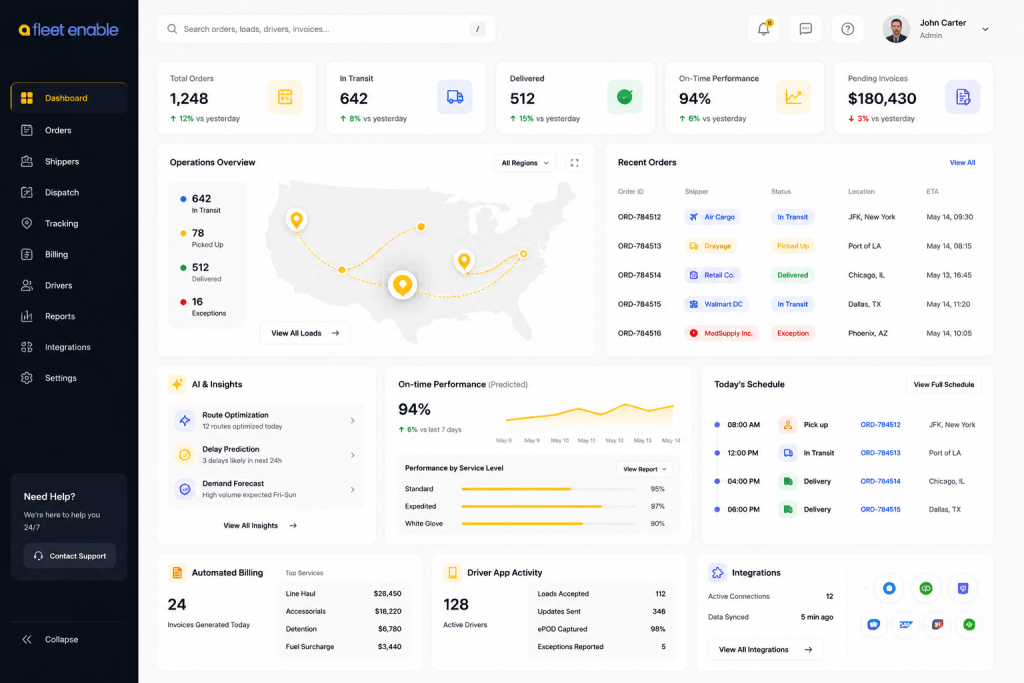
One Billing System. Every Way You Charge
Air Cargo & Cartage
Waiting time, captured and billed

White Glove
Stair carries and crews, priced right.

Drayage
Demurrage, before it surprises you.

Dedicated Fleets
Contract rates, applied automatically.
Linehaul
The middle mile, billed as its own leg.
Rating & Billing
Automated Billing
Built from what happened
Account Management
Every shipper, set up once
Rating & Billing
The invoice writes itself from the record
Stops, accessorials, and fuel priced automatically. Supporting documents assembled and attached before anyone reviews it. Bill by stop, by day, or by service level.
Two-step approval
Billing first, then the invoice.
Monthly cutoff
Revenue lands in the right month.
Posts to QuickBooks Online
No re-entry on the accounting side.
Account Management
Each account’s rates and rules, applied automatically
Rate matrices, accessorials, and fuel surcharges held against the account rather than looked up by whoever runs billing that week. Extra labor, an extra flight, a stair carry: priced the moment the order lands.
Rate matrices per shipper
The Dynamic Rating Engine prices the order on arrival.
Accessorials and fuel
Configured once, charged every time they happen.
Service levels and POD standards
Each shipper’s requirements travel with their orders.
Onboarding a new account
Configuration, not a development project.
Frequently Asked Questions
What is freight billing software?
Software that turns completed delivery work into an accurate invoice. For a final mile carrier, it prices stops, accessorials, and fuel, attaches the supporting documents, routes the invoice for approval, and tracks payment against it.
How does automated billing work for final mile carriers?
The invoice is built from the operational record rather than reconstructed afterward. What the driver captured at the stop, including waiting time and accessorials, is already priced when billing runs. Documents are attached before review.
Why do carriers lose money on accessorials?
Because accessorials happen in the field and get billed in the office, detention, stair carries, reattempts, and waiting time are recorded on paper or not at all, and by the time billing runs, there is no record to bill from.
What happens when a shipper rejects an invoice?
The rejection comes back with its reason and routes for correction rather than aging quietly. The correction goes out against the same record, so nothing has to be rebuilt.
Can Fleet Enable bill different shippers different ways?
Yes. Invoices can be issued by stop, by day, or by service level, depending on how each account is set up.
Does Fleet Enable connect to accounting software?
Yes. Invoices post to QuickBooks Online, so nothing is re-entered on the accounting side.
How does Fleet Enable handle different rates for different shippers?
Each account has its own rate matrix, accessorial schedule, and fuel surcharge configuration. When an order arrives, the rating engine prices it against that account's terms automatically, so nothing depends on someone remembering what a given shipper agreed to.
How long does it take to set up a new shipper?
Delivery locations, delivery specifications, rate matrix, and accessorials are configured for the account, and Fleet Enable's team handles the initial setup. Once configured, orders from that shipper price and route themselves.