
API/EDI INTEGRATIONS · FLEET ENABLE TMS
Your Shippers Already Have a Way They Send Orders
Fleet Enable connects through EDI, API, and direct integration, with 40+ shipper connections already built. Each partner’s mapping is held per relationship, so meeting a forwarder’s requirements does not mean building something new for every account.

Live Connections Across 40+ Shipper Systems











THE NUMBERS
The Integration Work Already Done
40+
Shipper Connections Live
800+
Shipper Accounts Configured
4
EDI Transaction Sets
6
Ways Orders Arrive
Enterprise Shippers Set the Terms. You Have to Meet Them
A forwarder or retailer will tell you which transaction sets they use, what status updates they expect, and how invoices reach them. Meeting those requirements is often essential to keeping the contract. Carriers who cannot meet them risk losing the account to one who can.
Fleet Enable handles the standard freight transaction sets natively and already runs 40+ shipper connections, each mapped against its own relationship. Adding your account on a connection we already run is configuration work with a tracked timeline, and it runs without an IT team on your side.




How Fleet Enable Connects
EDI Transaction Sets
204, 214, 990, 210 across 40+ connections.

API Access
Direct connection for systems that have one.

Per-Partner Mapping
Each relationship on its own terms.

Accounting Sync
Class-level GL mapping, books reconcile.

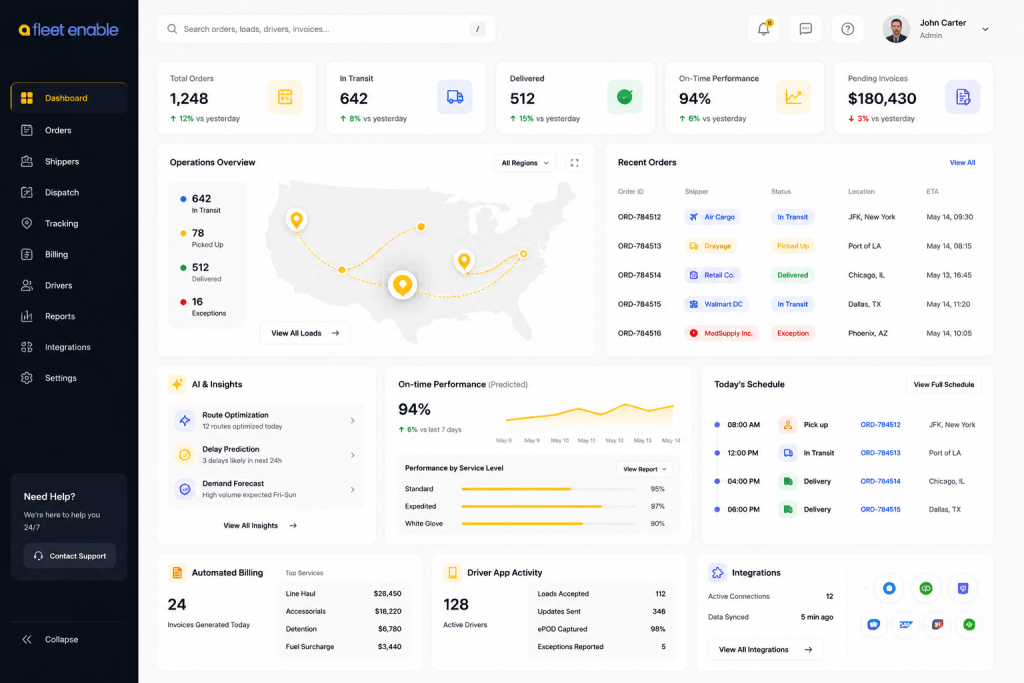
Connected To The System That Runs The Work
Works With
Order Management
Six ways orders arrive.

Automated Billing
Invoices out on delivery.

Document Management
Paperwork filed against the order.

Fleet Enable TMS
The platform it runs on.
Frequently Asked Questions
Which EDI transaction sets does Fleet Enable support?
Load tenders, status updates, invoices, and load tender responses are handled natively, covering the 204, 214, 210, and 990 transaction sets that most freight relationships run on, across more than 40 shipper connections already built.
Can Fleet Enable connect to our shipper's system directly?
Yes. Where a shipper runs an API or a direct feed instead of EDI, Fleet Enable connects to it the same way, and the mapping is still held against that specific relationship.
Do we need an IT team to set up an integration?
No. Fleet Enable's team handles the mapping and the testing with your partner. Your side is confirming the spec and approving the test file.
Can different partners have different requirements?
Yes, and most do. Every partner's mapping is held against that relationship, so one forwarder's status codes and another's invoice format sit side by side without affecting each other.
Does Fleet Enable connect to accounting systems?
Yes. Invoices post to QuickBooks and Sage with class-level GL mapping, so revenue lands where it belongs and the books reconcile without a second pass.
How do we know an integration is working?
Every transaction is logged with its acknowledgement, so you can see what was sent, what came back, and where a partner's system returned a rejection along with the reason it gave.